

December, 2023
from the Record, Fall 2023
by Alexandra Evans
The Keepers: Alumni in Public History
Set in what Caroline Emmons, director of the Center for Public History, calls a “laboratory of history,” Hampden-Sydney has always drawn historophiles. Emmons credits this to a number of factors including the position of the College both geographically and temporally in our nation’s history as well as the strength of the Hampden-Sydney History Department.
“Over the past 10 years, Hampden-Sydney College has graduated more history majors as a share of students than any other college or university in the nation. According to The American Historical Association, approximately 1.2 percent of undergraduates nationally majored in history between 2012 and 2022. Hampden-Sydney’s average across those ten years is 13.6 percent,” reports Elliott Associate Professor of History James Frusetta.
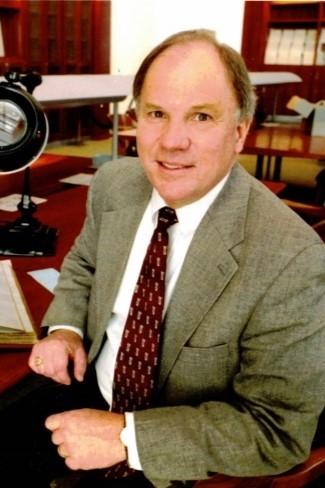
Discover how retired Virginia state archivist Conley Edwards ’67 used his history degree in his profession dedicated to the preservation, interpretation, and conservation of American history.
Conley Edwards ’67 points to the Pentagon Papers as a reminder of the need for transparency in governance, a philosophy he holds dear as an archivist. “When the Pentagon Papers came out, it affected people’s trust and confidence in government,” he explains. “One of the things that archivists strive for is to provide unedited materials so that average citizens can come in and investigate an issue or an incident and form their own opinions.”
Edwards was first introduced to archival work during graduate school at the University of Richmond, where he obtained his master of arts degree in American history after serving in the Army. He led a Herculean effort over the course of his 35-year career at the Library of Virginia growing the state archives from 47,500 items in 1974 to 109,221,000 upon Edwards retirement in 2009. Edwards says that the Library of Virginia’s staff has led the way in state archiving across the nation, and the state’s archive is among the most visited in the nation. “The importance of having an extensive collection is that the public has a right to access those materials to see if their money is being well-spent,” Edwards explains.
“The government is doing the people’s business and the people have a right to know how those decisions are being made and how that business is being done.”
Although archives are often associated with major historical treasures or high-level government documents such as the Pentagon Papers, Edwards argues that the everyday documents often end up being the most illuminating historical materials.
“There was a period of historiography where the story was really of Washington, Jefferson, Madison, Monroe— prominent figures like that,” Edwards says. “But in the late 20th century, the focus shifted to more personal stories of individual citizens at a local level. There’s no richer source of information than documents such as court proceedings or land deeds or tax records that depict life at a local level.”