

July 31, 2026
from the Record, Spring 2026
Trailblazer
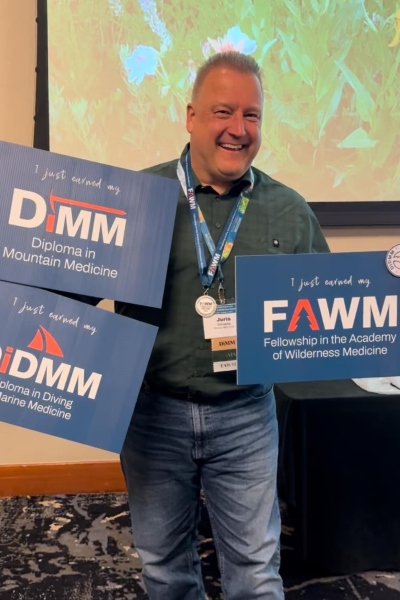
Rarefied air holds dual meaning for Juris Simanis ’91, who was among the first five people in the world to earn the distinction of being a Wilderness Medical Society (WMS) Triple Crown recipient, an achievement that required training at 10,000 feet.
The WMS Triple Crown requires completion of the Diploma in Mountain Medicine, the Diploma in Dive and Marine Medicine, and a Fellowship in the Wilderness Medical Society. The achievement places him among a small, deeply trained group of physicians who practice at the intersection of medicine, environment, and human endurance. There’s a reason so few practitioners have achieved this recognition. It takes years to acquire the necessary skills and training. Simanis began in 2017 and was officially recognized with the inaugural group of recipients in 2023.
“Wilderness can mean any place that is uninhabited, remote, or inhospitable,” Simanis explains. “Mountains, oceans, caves are obvious examples, but disaster zones in a big city can also count. Wilderness in this context is really anywhere you don’t have the controlled environment of a hospital or access to necessary resources.”
The Triple Crown is intentionally immersive, blending national conferences, lectures, and demanding field sessions. For the mountain diploma, Simanis trained in high-angle rescue in Utah and summited Washington State’s Mount Rainier with a 60-pound pack, spending days practicing crevasse rescue and cold-weather medicine. For the marine diploma, he completed advanced dive medicine coursework and a liveaboard expedition in the British Virgin Islands, studying hyperbaric injuries and marine hazards in real time.
“The physicality was the hardest part,” he says, noting that his descent of Rainier aggravated the knee that would later require replacement surgery. “I remember getting to the bottom and just feeling grateful I made it.”
A former EMT at Hampden-Sydney, Simanis traces his interest in field care to his undergraduate years, when a marine biology course in Jamaica sparked a lifelong love of diving. Raised in the Allegheny Mountains of Virginia, he grew up hiking, fishing, and hunting—activities that were less like hobbies and more like a way of life.
In remote settings, intuition and preparation must work together. “If you’ve never seen it, you can’t diagnose it,” he says. Training expands that mental database. Whether recognizing heat illness on a dive boat or spotting dangerous overhydration at the finish line of an endurance race, catching subtle warning signs often prevents the dramatic emergency.
A sports medicine physician with two public health degrees and Peace Corps experience, Simanis sees wilderness medicine as an extension of a broader philosophy: stay curious, stay humble, and stay open. “You have to be comfortable being uncomfortable,” he says. “The more you’re exposed to, the better you understand people—and the better physician you become.”