

July 31, 2026
from the Record, Spring 2026
by Alexandra Evans
Crafting an Entrepreneur
In its 10th year of operation, Richmond, Virginia-based Buskey Cider has beaten the odds. With a whopping 75 percent of small businesses closing before their 10th anniversary, according to the U.S. Bureau of Labor Statistics, Buskey Cider is a statistical success. Still, founder and CEO Will Correll ’13 is not so sure.
“Functionally, the business that I set out to open failed,” Correll says.
This isn’t a story about success or failure, though. It isn’t even a story about how to make great cider. It’s about the makings of an entrepreneur—a journey that began in earnest right here at Hampden-Sydney. Because to Correll, being an entrepreneur is about so much more than keeping the lights on and maintaining profit margins. It’s about calculated risk-taking to pivot when necessary and, most importantly to Correll, solving a problem in a way that creates the most common good.
Coincidentally, pivoting is both the reason Buskey exists at all and the reason Correll says it is a failure.
In November 2012, Correll and a classmate were signed up to pitch their automation software for tracking community service hours at the Start Peninsula competition in Hampton Roads, when an unforeseen set of circumstances necessitated a parting of ways the night before the competition. Correll was determined to compete, except he had no venture to pitch. There was one topic he had researched enough to speak on proficiently: craft cider.
Initially interested in craft beer like many of his peers at the time, Correll felt the market was already oversaturated. What he didn’t see well-represented in the market, though, was craft cider. The cider that was available wasn’t impressive—overly sweet, low-quality ingredients, brewed with a “soft drink mentality” as Correll puts it.
“I knew quite a lot about craft brewing, and I had accumulated probably 500 pages of research on cidermaking and feasibility studies that gave me a solid understanding of cider’s history and what it would take to open a cidery,” Correll says.
Armed with notes and nerve, Correll continued on to the competition, expecting to win nothing but experience pitching to investors. A combination of factors turned the wind in his favor: standing out with a unique venture in a sea of tech start-ups, a group of eager investors and mentors who felt snubbed by other groups, and an ability to persuade honed by the Hampden-Sydney Rhetoric Program. Correll walked away from the Start Peninsula competition with $10,000 and a small army of highly experienced businesspeople, who believed in him.
Correll now had real momentum, real mentors, and real money to invest in a booming market that would grow an additional 75.4 percent in the following two years according to Chicago-based research firm IRI (now Circana). He also had a full semester of college left to complete.
“I went to Dean Klein and told him I was seriously considering stepping away from school because I needed to hit this now. It was my moment,” Correll says. He goes on to recall that Dean of Students David Klein and Correll’s campus mentor Professor of Economics Jennifer Dirmeyer encouraged him to finish his degree, but they also emphasized that doing so should in no way stop him from seizing his moment. Together, Correll and the College curated an independent study program that fulfilled his remaining credit needs while moving his business forward. “My business plan became a class of its own. I took an environmental science course that focused on how to make the business more sustainable,” Correll explains. “Functionally I had a light course load my last semester, but it wasn’t a cake walk. I was working harder than anyone around me.”
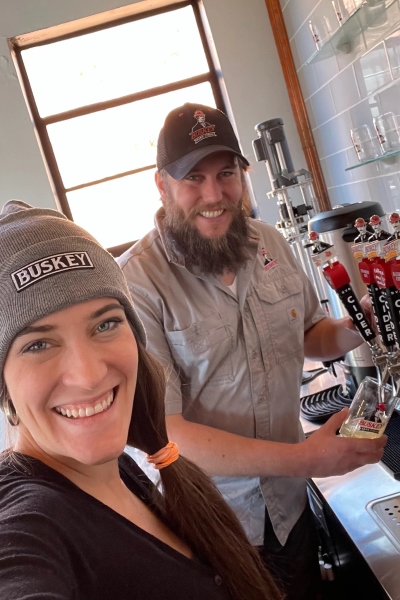
The 15 years since that pitch competition have been full of growth and continued hard work. By the time he graduated, Correll had anticipated being within months of cutting the ribbon on his cidery. That wasn’t the case. It would be another three years before he opened Buskey’s doors at 113 Leigh Street. By then, Correll had brought in Elle, his childhood friend and then girlfriend, to handle the marketing and public relations. The duo married about a year later and now share a son, Henry. The weekend they opened Buskey, Correll slept on the floor of the cidery after the lock to the front door broke. Since then, Correll has weathered a global pandemic—forgoing his own salary to ensure his employees got paid—encountered a rapidly changing industry with unpredictable consumer preferences, and failed to make the original model of scaled distribution work. In fact, Correll says the only reason they’re still in business is because they own the 6,000-square-foot warehouse that Buskey calls home, a shrewd move that many businessmen more experienced than Correll was at the time may not have seized.
“If you can help it, don’t become an entrepreneur,” Correll says in all seriousness. Unfortunately for Correll, he can’t help it.
He may not have solved the cider problem per se, but Correll is using Buskey as a vehicle to solve other problems that he’s identified in his community—the second pillar of his entrepreneurial ethos. Particularly in the post-COVID landscape that has left many feeling isolated, Correll aims to make the Scott’s Addition-based cidery a gathering place. Scott’s Addition has been referred to as the Virginia capital city’s thirstiest neighborhood given its high number of breweries, cideries, and distilleries. More than booze though, the city is thirsty for community. Seeing families coming in with small children (coupled with a fresh frame of reference as new parents themselves), the Corrells added kid-friendly amenities to the bathrooms and chalkboards to the common areas. He and Elle have added food offerings and new product categories to serve a wider range of customers. They are exploring ways to host events at the cidery.
Correll may insist that the business he set out to build failed. But can something that meets needs and serves people ever really be a failure? More than creating good cider, Buskey creates common good. If only that could be bottled. Or, in this case, canned.