

October 21, 2026
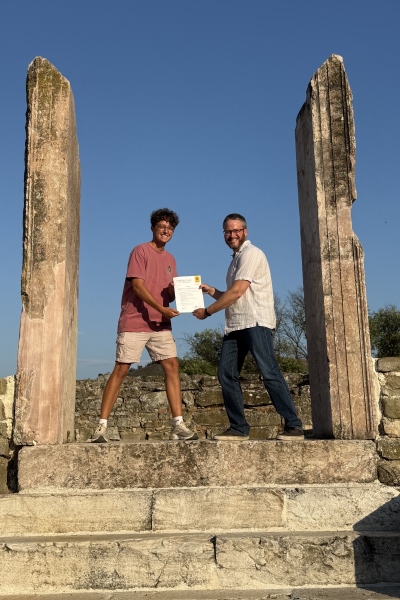
From June 6 to July 4, Dylan Evans ’27 visited North Macedonia and participated in a field school at the archaeological site of Stobi, while learning about ancient Mediterranean archaeology.
 During the summer, students travel abroad to explore new places, engage in hands-on learning, and immerse themselves in the rich histories and cultures of communities around the world. For Dylan, that opportunity came through Visiting Assistant Professor of Classics Matthew Schueller, with whom Dylan joined 16 other students from North America for a unique archaeological experience.
The archaeological site of Stobi is located near the village of Gradsko in central North Macedonia. The Stobi Field School, established in 2010, is coordinated by the non-profit Balkan Heritage Field School in partnership with the National Institution Stobi. The program offers undergraduate and graduate students, as well as adult learners from around the world, a month-long opportunity to explore ancient Roman archaeology through excavations, lectures, analysis workshops, and excursions to nearby archaeological sites and museums. Throughout the experience, participants gain valuable hands-on experience while discovering the rich history of the ancient Mediterranean world.
“I’ve always been passionate about Roman and Greek history," Dylan says. "When Dr. Schueller mentioned his involvement with the Stobi program during Greek Literature in English class, I was eager to participate.”
Dr. Schueller has served as a volunteer instructor with the Balkan Heritage Foundation since 2010 and has coordinated the field school at Stobi on behalf of the Foundation, in partnership with Stobi’s archaeologists, since 2022. Leading the experience alongside his North Macedonian colleagues, Dr. Schueller was eager to share the experience with Dylan and watch him grow throughout the program.
Arriving on June 6, Dylan jumped right in with an orientation tour of the historic site at Stobi, exploring previously excavated buildings and areas, some featuring beautiful mosaics. Each day began at 6 am, with the group arriving at the excavation site by 6:45 am. Using pickaxes, hoes, shovels, and trowels, participants cleared excavation areas and frequently uncovered pottery sherds, glass, nails, metal, and coins. They cataloged, labeled, and sorted their findings into bags to bring to the lab for further analysis. Afternoons featured lectures and workshops led by excavation supervisors, including Dr. Schueller, covering topics such as pottery processing, archaeological drawing, the history of Stobi, and interpreting uncovered artifacts and situations for what they reveal about the past.
Weekends offered exciting opportunities to explore the region’s rich history through excursions to nearby cities and archaeological sites. Dylan visited Bitola, North Macedonia, to explore the ancient city of Heraclea Lyncestis, as well as Ohrid, a UNESCO world heritage town that was once the ancient city of Lychnidos. Other trips included Skopje, the capital of North Macedonia; and Thessaloniki, Greece; along with Pella, the birthplace of Alexander the Great.
“Being able to work and study alongside Dr. Schueller, the other instructors, and fellow students was a great experience and provided a valuable experiential learning opportunity,” Dylan says. “The experience was incredibly insightful. Our instructors’ knowledge of glass, pottery, and architecture was amazing, and it was important to understand the significance of each step we took at the excavation site.”
Dr. Schueller enjoyed watching Dylan explore his passion for archaeology and expand his knowledge. Reflecting on Dylan’s experience, Dr. Schueller emphasized the collaborative nature of archaeological work through this experience: “I think what is not easy to understand about archaeology is how much of a team-based activity it is. I was glad to see that Dylan really dove into that, worked with his team, and learned the importance of embracing that camaraderie, whether digging in the dirt, documenting finds as they come up, or taking that team-based approach back to the lab to record and clean materials so they can be preserved and studied in the future.”
Drawing on the knowledge he gained in North Macedonia and his background in mathematical economics, Dylan plans to incorporate his experience in North Macedonia into his honors capstone project, which will examine economic transformations in provincial Macedonia in late antiquity. For Dylan, it’s a fitting and unique way to build on his passion while applying his newfound knowledge to a deeper understanding of the region’s history.