

June 17, 2026
from the Record, Fall 2025
The Sticks You Have
By Alexandra Evans
When Afghanistan fell back into the hands of the Taliban in 2021, Kamal Iqbal '27 and his family were forced into hiding. With their ties to the U.S. Embassy in Kabul, the Iqbal family was high on the Taliban's hit list—with the new government actively trying to track them down, calling their home and questioning their neighbors as to the family's whereabouts.
With all flights out of the country grounded and Taliban soldiers at every checkpoint, it took the Iqbal family nearly four months to safely cross the border into Pakistan. They left behind everything but each other. More than personal belongings and documents, though, Kamal and his family lost their very sense of home. As long as the Taliban is in power, the Iqbals will live in exile from their ancestral land.
FAMILY
The youngest of six children, Kamal lost his father, Mohammad Nasim, to skin cancer when he was only one year old. His mother, Bibi Hurmat Amiri, carried the weight of raising six children alone. "My mother has been my greatest strength, carrying our family with patience, faith, and endless sacrifice. As hard as it was on my mother," Kamal says, "I can't imagine how hard the thought of leaving his family behind was on my dad. Cancer is bad, but the stress of knowing he was leaving his family behind is maybe the other thing that killed him."
Despite the loss, Kamal's memories of childhood in Afghanistan are filled with warmth. "We were together, and that was what mattered."
When the Taliban returned to power, that togetherness was shattered. Kamal's eldest brother,Islam, had worked as an education advisor for the U.S. Embassy in Kabul. His efforts to support Afghan youth—especially women—seeking higher education in America made him a target. Mere hours before the Taliban seized Kabul, Islam fled the country, just days after celebrating his wedding in Mazar-i-Sharif. Islam eventually resettled in Canada, where he has become an outspoken advocate for refugees and immigrants, even addressing the 2024 World Economic Forum on the topic in Davos.
The Iqbals were now scattered across four countries: Islam in Canada; his sister, Zarmina, studying at a university in Qatar; his brother Zia in South Korea; and Kamal, his brothers Ekram and Jamal, and their mother in Pakistan. "We lost our home," he says, "and we were no longer all together."
Islam, whom Kamal says guided him like a second father, reminded Kamal that though the family had lost their material things, their true wealth was in their mindset and their education.
RESILIENCE IN EXILE
 Kamal had always dreamt of studying biology in the U.S. and had been preparing to study for the SAT when the Taliban returned to power. Now in Pakistan, with only a few PDFs of SAT prep documents that weren't even in his native language, a handful of pens, and a notepad, Kamal committed to studying, often up to 10 hours a day in a sweltering room with no air conditioning and intermittent electricity. "When you don't have anything," he says, "you start with the sticks that you do have—and you build from there."
For two years, Kamal studied, preparing himself to take the SAT and begin applying to colleges. One of the sticks Kamal held on to during this time was his goal of becoming an oncology physician assistant in honor of his father's battle with cancer.
"It has been difficult not having memories of my father," Kamal says. "Though, in some ways, it has defined my life. I want to help patients and families fight this horrific disease and give them hope."
After taking the SAT twice, Kamal was satisfied with his score, and he began the college search. Stumbling upon Hampden-Sydney's website among the list of Common App schools, Kamal was drawn in by the Honor Code and the College's mission of forming good men and good citizens. "Honor means doing what's right, even when no one is watching," Kamal says. "I like that Hampden-Sydney's entire mission emphasizes ‘forming good men and good citizens' through moral character, sound learning, and responsible leadership. Because I grew up valuing honesty and respect, I felt H-SC would feel like home: a community where people treat each other with dignity, where trust is real, and where I could grow not just in knowledge, but in character. That made me want to be part of it."
Then there was the daunting task of collecting the documents needed to apply to college. Kamal was able to get in touch with friends back in Afghanistan who rallied behind him and located and sent the required documents. Other friends and family members assisted Kamal in setting up bank accounts and providing financial support to cover application and student visa fees.
"It's really hard to just get an interview for student visas, and even then, more than 90 percent of student visa applications are rejected," Kamal says. "Even after all that work, there was a good chance I would not be able to go anywhere. But I said, at least I will try."
Having to wait more than a month for an appointment, Kamal went in for his visa interview on July 19, 2023. After just two questions from the interviewer, he walked out with a yellow slip of paper—rejected.
THE TURN BACK MOMENT
In 1991, a young Steve Harvey was living in his car, with just $35 to his name and all his worldly possessions in two bags, trying to break into show business. On the verge of giving up, Harvey receives an invitation to perform at the Apollo. Not knowing how to turn $35 into a plane ticket from Pensacola, Florida, to New York City, Harvey had arrived at his turn back moment. Forging ahead, he arrived in New York City two days later and soon after became the longest-running host of Showtime at the Apollo.
Harvey later recalled this story to a captivated audience, saying that, "In your life, everybody has a turn back moment. You have a moment where you can go forward or you can give up. But the thing you have to keep in mind before you give up is that if you give up, the guarantee is it will never happen. That's the guarantee of quitting."
Kamal says his initial visa rejection was his turn back moment. "I had come this far, though," Kamal remembers. "I had to see it through to the end."
Applying for another interview was Kamal's first hurdle. He was given an interview date in October, but to start the school year on time, he needed to have his visa in hand by August 15—coincidentally, two years to the day that the Taliban recaptured Kabul. With no existing avenue to request an expedited appointment for a student visa, Kamal turned to the alumni network he will one day join. Hugo Rodriguez '88, former principal deputy assistant secretary with the Bureau of Consular Affairs, assisted Kamal with securing a timely interview appointment. "Ensuring outstanding international students like Kamal have the opportunity to study and engage with U.S. culture at a place like Hampden-Sydney is in our national interest," says Rodriguez, now H-SC Wheat chair of leadership. "I was happy to help him find a way to get the visa issued in time for classes. One of the best parts of my former job!"
"I have never met such kind people in my life. That's what makes this college special, and that's why we have such a great alumni network, because people help each other without expecting anything."
~ Kamal Iqbal '27
Going into his second interview, Kamal admits that he had very little hope left, but he had spent extensive time preparing for the interview and sought the help of Director of Global Education Dani Widdows and Assistant Dean of Students for Student Conduct Dwayne Bowyer '92. After a much more fulsome interview, Kamal left with the blue slip—approved.
COMING TO AMERICA
"I was in disbelief," Kamal says, almost as though he still can't quite believe it.
From a shy boy who would cry if he had to sit next to anyone but his brother in school, to leaving his family to pursue college in a country he had never been to, Kamal was growing stronger by the day.
With just a few days until classes started, Kamal and his family began making arrangements for his journey. On August 21, 2023, Kamal headed to the Islamabad International Airport (ISB) for the first leg of his journey, and his first plane ride ever. But things weren't about to get easy now. Because of a baggage agreement issue with the airline provider on the second leg of his journey, ISB airport employees told Kamal that he could only bring half of his bags, and he had just minutes to decide, or he would miss his flight, rendering his visa invalid.
"I came to the U.S. with just with one carry-on bag," Kamal remembers. "Because there was an issue with my flight ticket, they did not let me take all my belongings with me. I had to send the rest of my belongings home to my family with the help of a taxi driver."
Once in the air on the first leg of his trip from Pakistan to Abu Dhabi, Kamal had a moment to think, and the doubts began. "All of a sudden, I wasn't sure that what I was doing was right," he says. "I had spent two years trying to get to this point, but I was also leaving everything behind. I had no idea when I would see my family again."
There was no turning back, though, so Kamal continued on, boarding his second flight from Abu Dhabi to Belgium, and finally landing in Washington D.C., where a shuttle was waiting to bring him on the last leg of his journey to the Hill.
A NEW WORLD
 More than 35 hours after leaving his family at ISB, Kamal arrived at Hampden-Sydney on August 22, 2023. He was greeted by his new Hampden-Sydney brothers, who gathered outside of Carpenter X to welcome him home. "I cannot describe the feeling I had when I finally got to Hampden-Sydney," Kamal says. "No one can possibly understand it unless they've been through a similar experience."
"Kamal was quiet during the first few days," says his freshman-year roommate, Alexander Albright '27, "as I would expect anybody moving to a foreign country might be. Over time, we opened up to each other. We became fast friends, and we've been hanging out ever since. I've learned a lot from Kamal, and I admire him a lot. He's been through a lot of challenges in his life, but he doesn't fret over every single inconvenience. I'm proud of how far he's come in the two years since he's started here."
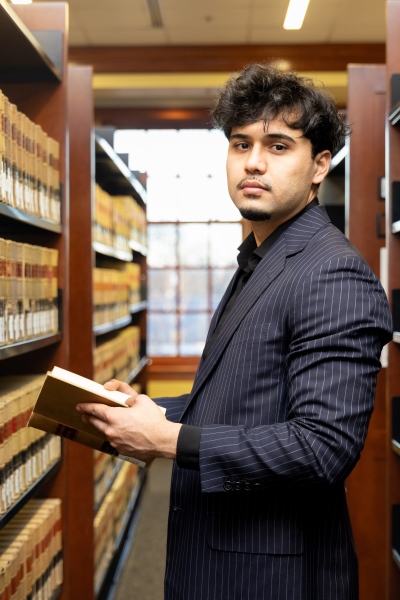
When the sun rose the next morning, Kamal hit the ground running, already two days behind his fellow students. Kamal says that his memories from the first few days on campus are dark, as he just focused on finding his way around and catching up on missed classwork. Retaining the same drive he had when studying for the SAT, Kamal spent hours each day in Bortz Library.
"It was very hard at first," he recalls. "But it's like anything you do for the first time, like going to the gym, it gets easier with time. You just have to stay consistent."
Things have gotten easier for Kamal. He has made friends, maintains a 3.5 GPA, and is able to look to the future. The food, though, is still a big adjustment for him.
"My family are at home eating the good food," he laughs. "I miss bolani and mantu the most. My mom and my sister always made them for me, and they feel like home." Kamal now enjoys a few American delicacies like buffalo wings and chicken burgers.
While he would love for his biggest worry to be where he'll go for spring break, Kamal still deals with hurdles most people can't understand. Just last summer, Kamal was forced to live in his car for a week after he was unable to make rent, another parallel with Steve Harvey's own story. Then there are bigger challenges, such as seeking legal asylum on his own, having no financial means to secure a lawyer, and relying on the guidance of family members who have been through the asylum process already.
 "Kamal has been an incredible addition to the College community and the Hampden-Sydney brotherhood," says Dean Bowyer. "He is wise beyond his years, and the students who have taken the time to know Kamal and understand his background have benefited greatly. Kamal's story of family tragedy, personal struggle, desire to learn and grow, and his resiliency to seek opportunities for himself and his family is inspirational."
The Hampden-Sydney community has been there for Kamal time and again, reaffirming what initially drew him to the College. Dr. Widdows, Dean Bowyer, and Mr. Rodriguez went above and beyond to support Kamal through the visa and travel process. Facilities and the Office of Student Affairs ensured he had bedding and school supplies upon arrival. The Office of Student Affairs helped him purchase clothes and other necessities with the One Brotherhood Fund. Kamal's advisor, McGavacks Professor of Biology Mike Wolyniak, offers unwavering support and encouragement. When he lost his sponsor, Kamal feared he would have to withdraw from school until Hampden-Sydney stepped in with additional funding to keep him enrolled.
"The people that work here, they help without expecting anything," Kamal says. "I have never met such kind people in my life. That's what makes this college special, and that's why we have such a great alumni network, because people help each other without expecting anything. One day, if I become successful, I will come back and help some other student. Each one must teach one."
THE LIGHT AHEAD
For now, Kamal is focusing on the tasks in front of him, completing his undergraduate degree, applying to physician assistant programs, and seeing his asylum case through. Kamal isn't waiting until he graduates to make the difference he can, though. He is already taking an EMT class, and he runs an Instagram account and website that provides free guidance to international students on the U.S. college admissions process.
"Life can be difficult," he says. "I have not had an easy life, but I can't let the past affect my mind and distract me. Because if I lose my mind, it doesn't matter what else I do. I have to keep my mind safe and focus on the sticks I have."
For Kamal, those sticks—his mindset, his education, his vision—have become the foundation of something inspirational: a life rebuilt stick-by-stick from the ground up, not in the shadow of what was lost, but in the light of what is still to come.