
Classics
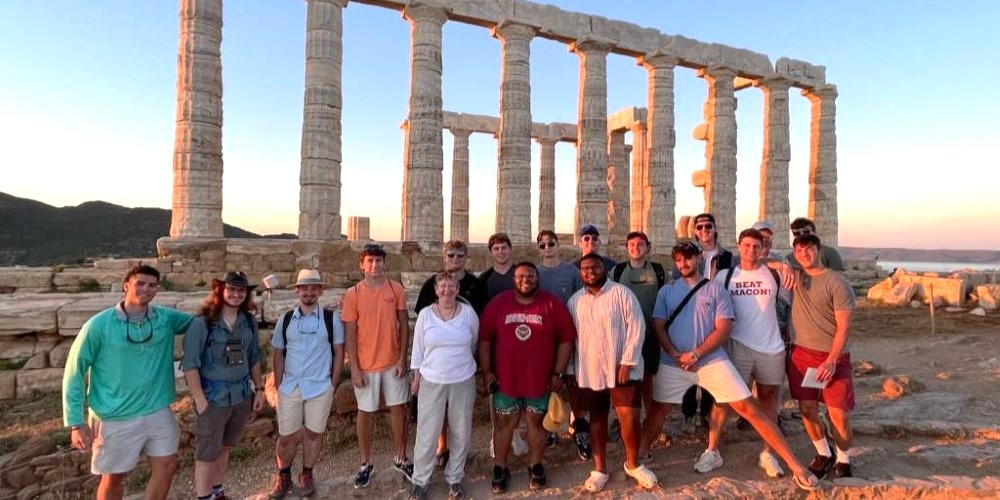
The Department of Classics offers a wide range of courses in the languages, literature, history, and cultures of ancient Greece and Rome as well as courses that celebrate their enduring intellectual and artistic influence on ages since antiquity, up to and including our own 21st century.
Degree Offerings
- Classical Studies Major and Minor
- Classics and Ancient Languages Major
- Greek Minor
- Latin Minor
Classics Department Newsletters
"When you're studying Greek, you get used to not having the answers and not feeling totally comfortable with the material. I came to like this feeling, and it helped me carve out my own space in the marketplace and invent myself as an entrepreneur."
-Tyler Barstow '10
“In studying the Classics at Hampden-Sydney, I found myself not only refining my translation skills but elevating my knowledge in other fields as well. Politics, economics, and law were all intertwined in my studies culminating in a broad and robust educational experience.”
-George Jackson '25
In "The History Net on Why Study the Classics?" ThoughtCo. explores the benefits of Classical Studies.
Read more text from the voices of great intellects including Jefferson, Thoreau, Johnson, and de Tocqueville on "Why Classics?"
Objects of cultural significance often come to colleges, where they are deposited by their owners in the expectation that they will enrich learning. Many times these gifts are relatively informal and little is known about them before they come to the institution. Such is the case with the Hampden-Sydney amphora, a gift in 1962 of Dr. J. William Hinton of New York City.
 Not an alumnus, but awarded an honorary Doctorate of Letters in 1961, Dr. Hinton was impressed by the place ancient cultures held in the Hampden-Sydney curriculum. His gift to the then-newly-opened Eggleston Library also included a small collection of ancient coins, as well as a fragmentary marble head of a child. For whatever reason, the amphora, usually kept in the Rare Book Room of the library, attracted little attention over the years. And, as is often the case with gifts of this sort, there is no file on the object as one would find in a museum.
Researching the Amphora, 2000
In conjunction with the Trojan War symposium in 2000, Mary Prevo, Instructor in Fine Arts, undertook research on the amphora so that it might be used more productively as a teaching tool. Hampden-Sydney colleagues James Arieti, Pam Fox, Sharon Goad, Richard McClintock, and Lorie Mastemaker, all helped her in the preparation and presentation of this research, in a display in the Atkinson Museum. Also lending invaluable expertise were Sharon Koehler, conservator in private practice, and Dr. Margaret Ellen Mayo, Curator of Ancient Art, Virginia Museum of Fine Arts.
Eta Sigma Phi, the national honorary classical society, was founded at the University of Chicago in 1924, and Beta Theta chapter was established at H-SC in 1942. Eligibility includes demonstration of high proficiency in the study of the classics, completion of at least three semesters of Latin or Greek with an appropriate scholastic average.
Advisor: Dr. Paul Hay

Classics Department
Dr. Paul Hay, Chair
Assistant Professor of Classics
Morton Hall, 201
Hampden-Sydney College | Hampden Sydney, VA 23943
(434) 223-6982
phay@hsc.edu